

Customer Experience
Guided Selling in B2B: Leading Customers Confidently to the Right Product
Customers increasingly want to research and buy on their own. With products that need explaining, however, unguided self-service quickly reaches its limits. Guided selling closes exactly this gap: it leads prospects step by step to the right product without sales having to accompany every selection process personally. For B2B companies with large catalogs, many variants, complex dependencies or regulatory requirements, this is far more than a nice-to-have: it reduces uncertainty, prevents abandoned purchases and increases the likelihood of a successful deal.

An article by Baris Cirak, Marketing & AI Consultant
Published: 22/07/2026
Reading time: 8.1 Min

Contents
What guided selling is
Guided selling is a digital, dialog-based form of decision support. Through targeted questions about the application, framework conditions and requirements, the system translates the customer’s needs into concrete selection criteria, narrows down the range and recommends suitable products or configurations. In this way, guided selling transfers the logic of a good sales consultation into a digital process.
In B2B, the right choice often depends on clearly defined technical criteria: technical compatibility, country of use, industry, quantities, existing systems or regulatory requirements. This is exactly where guided selling plays to its strengths. It is particularly suitable when:
- The product range needs explaining: many variants, configurations or combinations that the customer cannot keep track of.
- The right choice depends on external factors: location, target market, regulations, existing systems.
- Sales spends a lot of time explaining today: if the same consulting questions are answered by phone or email again and again, this knowledge can be turned into a guided journey.
Guided selling starts with the need: A classic filter assumes that customers already know which properties to look for. A product configurator usually assembles a solution that is already known. Guided selling starts earlier and first helps answer the question of which solution fits the specific need at all.
Why self-service alone is not enough in B2B
B2B purchasing is increasingly self-directed and takes place through digital channels. According to a recent Gartner survey, 67 percent of B2B buyers prefer a buying experience without direct contact with sales. At the same time, an average buying group now includes eleven active members – with different requirements, perspectives and decision criteria.
However, digital independence does not automatically lead to confident decisions. Buyers need guidance especially when it comes to whether a product or solution fits their specific need. According to Gartner, the likelihood of a high-quality deal increases by a factor of 1.8 when digital tools and personal sales work together effectively.
This is exactly where guided selling comes in: recurring consulting knowledge is transferred into a digital decision journey. Customers can orient themselves independently and are handed over to sales where individual advice makes sense.
67 %
of B2B buyers prefer a buying experience without direct contact with sales.
11
stakeholders are involved in a B2B buying decision on average.
1,8x
more likely to close a high-quality deal when digital tools and sales work together.
Benefits of guided selling
The benefits of guided selling show on two sides: for your customers and within your own company.
For customers, it means:
Faster to the right choice: A few targeted questions narrow down an extensive range and lead customers to relevant products or solutions.
More confident decisions: Transparent recommendations show why a product matches the stated requirements and reduce uncertainty and follow-up questions.
Fewer wrong purchases: Technical exclusion criteria prevent unsuitable recommendations and reduce the risk of incorrect orders.
Advice around the clock: Digital advice is available regardless of the sales team’s business hours.
For the provider, it means:
Higher conversion: There are fewer drop-offs in the selection process because the customer reaches the goal faster.
Relief for sales: Instead of answering recurring consulting questions by phone again and again, they are turned into logic once.
Valuable sales data: Every session reveals what the customer is looking for and in which constellation. This creates valuable insights.
Scalable consulting quality: Technical product knowledge is available to all prospects in consistent quality.
Areas of application
Guided selling tools are not equally worthwhile everywhere. They pay off where the buying decision is complex and sales spends a lot of time explaining today.
Typical beneficiaries:

Manufacturers with a complex range
Many variants, technical dependencies and high compatibility requirements.

B2B wholesalers with a broad range
Large catalogs where search and navigation quickly reach their limits.

Providers of regulated solutions
The right solution depends on country, industry, standards or legal requirements.
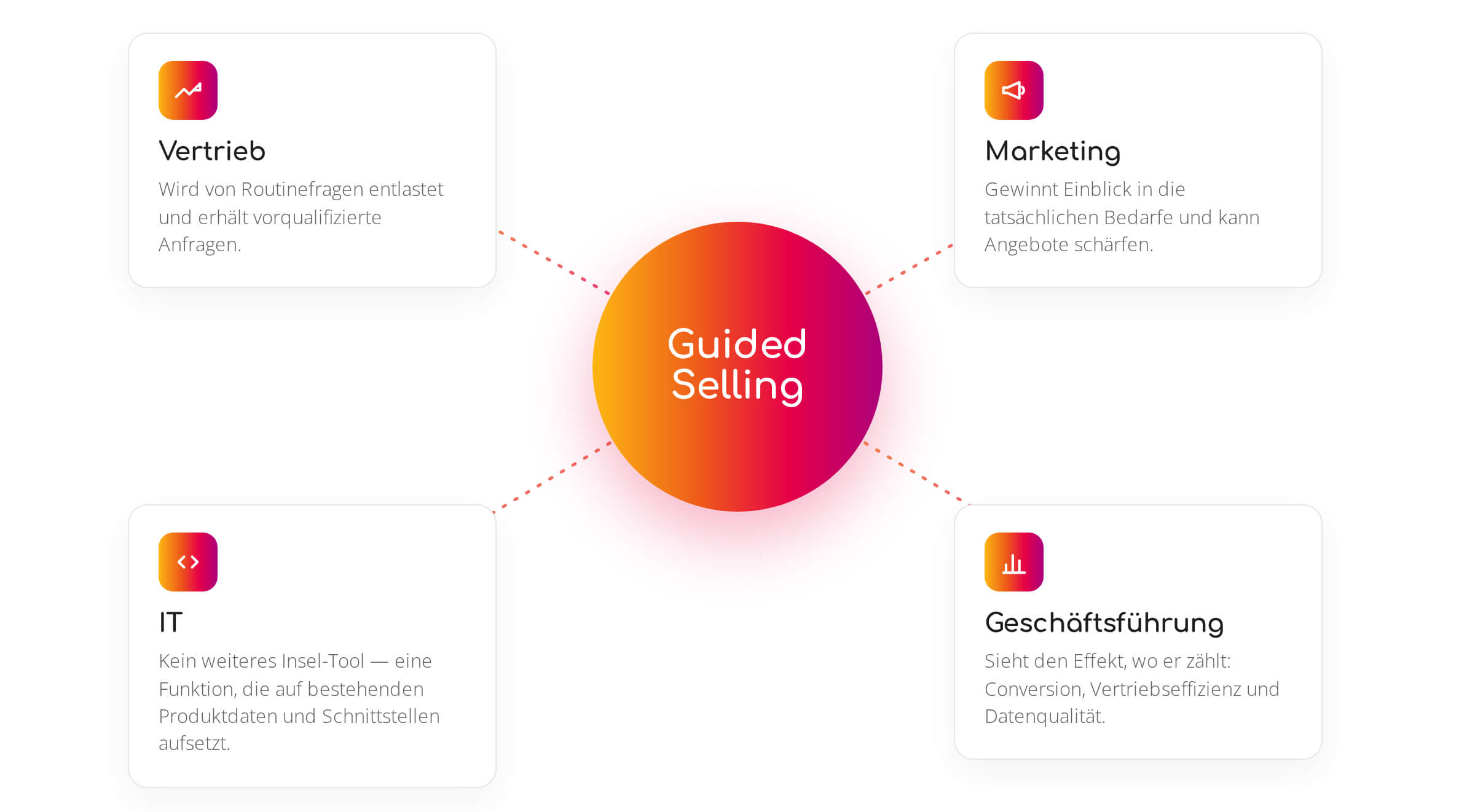
Several roles within the company benefit as well:
Practical example: the “compliance advisor” in an international shop
A project for our customer Landbell in the field of environmental and product compliance shows what this looks like in practice. The company sells compliance services and licenses internationally, for example for batteries or packaging. This is a textbook example of B2B sales that need explaining: which license or service a company actually needs depends on its registered office, the countries it sells to and the type of product.
XIM implemented a guided journey for this that appears in the shop as a “compliance advisor”. It leads through five steps:
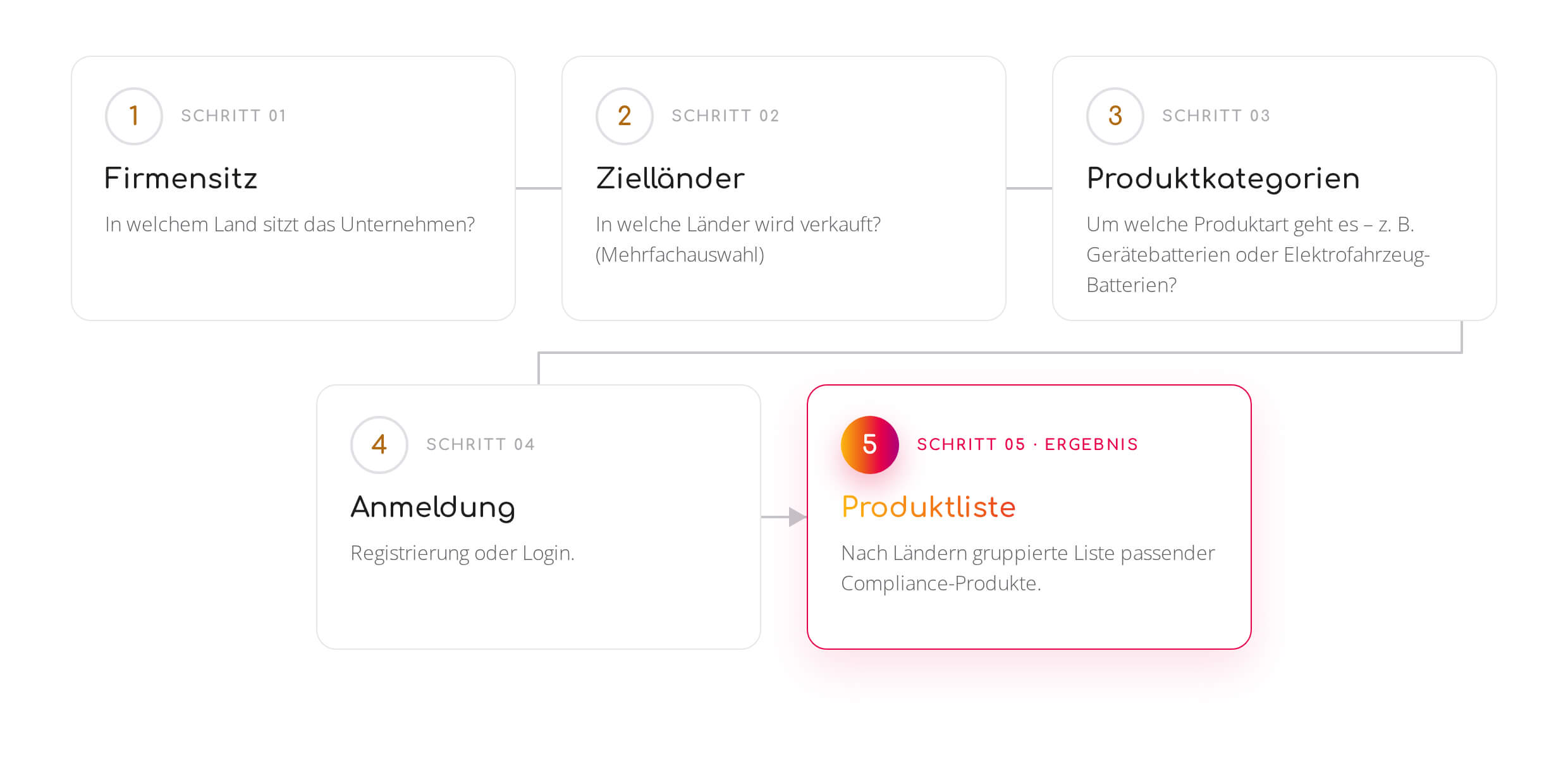
The decisive point lies between step 3 and step 5: the three customer inputs are translated on the server side into a precise product search that combines the category of the registered office with the target country and the product category. The customer does not have to understand the underlying regulations but simply answers three questions and receives matching results. The complex country and rule logic stays in the background.
What matters in implementation
Based on our project experience, a few principles can be derived that apply beyond the individual case.
- Few, good questions: every step must represent a real branch. Questions that do not change the result should be removed.
- Data model first: product attributes, exclusion criteria and dependencies must be defined first. Only then should the interface be designed.
- Result instead of dead end: even with unusual combinations, the customer should get a meaningful answer. If necessary, they should receive a hint or an offer of advice instead of an empty list.
- Connect to existing systems: the added value comes when guided selling works together with shop search, PIM and CRM and is not used as an isolated solution.
Conclusion: guidance for customers, added value for companies
Guided selling combines the independence of digital purchasing with the guidance of a structured consultation. Especially with complex ranges, many variants or regulatory dependencies, it helps B2B customers reach a suitable solution faster.
The decisive success factor does not lie in the interface alone. Only clean product data, transparent rule logic and the integration of shop, PIM, ERP and CRM make recommendations reliable and maintainable in the long term. The example of Landbell’s compliance advisor shows how a complex regulatory matter can be translated into a few understandable steps – while generating structured, pre-qualified inquiries for sales at the same time.
Is guided selling right for your product range? Together we will look at where your customers need guidance, which product data and rules already exist and what a sensible decision journey could look like.